
|
|
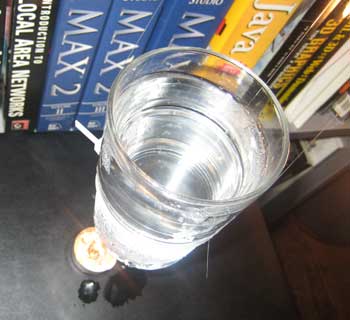
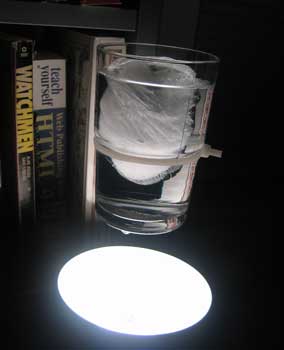
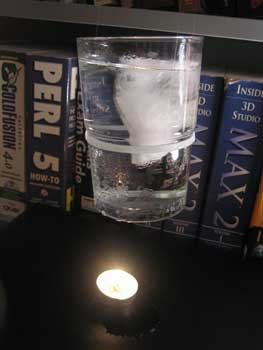
After 105 minutes, the ice above the candle was completely melted. Tealight wins!! There were many questions about the suspension of the glasses. A zip-tie was under the armpits of the glass, with three fishing lines holding the glass from above. It took a really long time to get the glasses at an equal height above their heat sources.
|
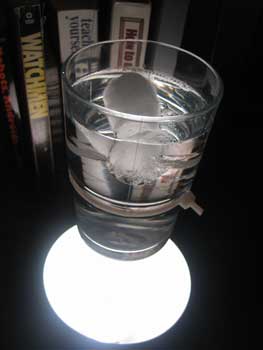
Here is a photo of the lightbulb ice after 105 minutes. Just a little plug of ice remained, which would have melted in about 15 minutes. The heat required to melt 300 grams of ice, (80 calories per gram) is 24,000 calories. An output of 24000 calories in 105 minutes is just under 16 watts, so I guess most of the bulb's energy really is converted to light, not heat. |
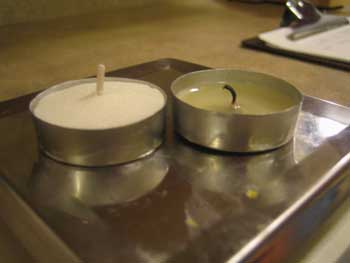
The tealight candle was lit for almost two hours, burning 4 grams of wax. The 100 Watt lightbulb used about 0.2 Kwh of electricity in two hours, which sells for about two cents in Sacramento.
I hope you aren't getting sick of these experiments. Thank you for reading them and for providing all those great answers! |
Shooting Free Throws | cockeyed science club | cockeyed home | Contact Rob | the guesses
February 3rd, 2006